
Consider a patient who has undergone imaging at a regional hospital and is subsequently referred to a specialist at a metropolitan hospital. The specialist needs the original images and reports, and a radiologist may need those images for comparison with a new examination. Both should be able to access the relevant history through the systems they already use.
That sounds like a straightforward information-sharing problem. It becomes considerably more interesting when the hospitals have different patient identifiers, different examination codes, independently managed radiology systems and different approaches to storing and retrieving images.
These were the kinds of problems we faced when implementing the NSW Health Enterprise Imaging Repository (EIR) in the early 2010s. I was a lead engineer working on the imaging repository implementation as part of the wider project team, at a time when Healthinc was the Australian technology partner of TeraMedica. Fujitsu was the prime contractor, and TeraMedica’s Evercore platform provided the vendor-neutral archiving technology.
Looking back, the technical lessons from that project remain highly relevant to the way we design enterprise imaging and clinical information infrastructure today.
What makes a vendor-neutral archive different?
A picture archiving and communication system (PACS) is principally concerned with the acquisition, management, display and use of medical images within an imaging workflow. It typically has its own archive, and that archive may work very well for the applications and departments it supports.
A vendor-neutral archive (VNA) separates the durable management of clinical content from the applications that acquire or use it. This makes it possible, subject to the supported interfaces and agreed information model, for multiple systems to store and retrieve content independently of the original application.
The distinction matters when an organisation changes its PACS, introduces another specialist application or expands the number of departments and facilities it supports. The useful life of the clinical information is often much longer than the useful life of the system that first acquired it.
TeraMedica was among the early pioneers of this architecture. Its Evercore platform was designed to support enterprise-scale content management across multiple organisations and applications. Its organisational model and storage management capabilities were particularly relevant to a statewide deployment. TeraMedica was subsequently acquired by Fujifilm in 2015.
The term VNA has since been applied to a wide variety of products. It is worth examining what a proposed system actually does rather than relying on the label alone.
| Capability | Question to ask |
|---|---|
| Application independence | Can other applications retrieve and use the content without dependence on the original PACS? |
| Patient and study context | Can information from different identifier domains be associated reliably? |
| Organisational boundaries | Can distinct facilities or clinical services retain appropriate control over their content? |
| Lifecycle management | Can retention, availability and storage policies be managed independently of departmental applications? |
| Interoperability | How does the system handle differences in the meaning and implementation of clinical information? |
A DICOM interface is an important part of the answer for medical imaging, but it is not the whole answer.
The NSW EIR: connecting existing imaging systems
The EIR was designed to connect the imaging infrastructure already operating across NSW public hospitals. Its purpose was to make images and reports available beyond the facility where they were created, without requiring every department to use the same RIS or PACS.
The pilot included the Children’s Hospital at Westmead, Western Sydney and Nepean Blue Mountains. This was a useful test of the architecture because it involved different imaging platforms, including systems supporting both adult and paediatric care.
The repository began going live in 2012. In his 2014 account of the program, EIR program manager Freeman Wong described ten RIS/PACS implementations from four vendors, alongside multiple patient administration, electronic medical record and interface engine environments.
In November 2013, HealthShare NSW received the NSW Premier’s Award in the Improving Performance and Accountability category for the EIR program. It was a collective achievement involving NSW Health, Fujitsu, TeraMedica, Healthinc and the many clinical and technical teams working across the participating organisations.
The longer-term value of the infrastructure is evident in eHealth NSW’s account of the EIR, which describes its continuing role in statewide imaging access and as storage infrastructure for the newer RIS-PACS platform.
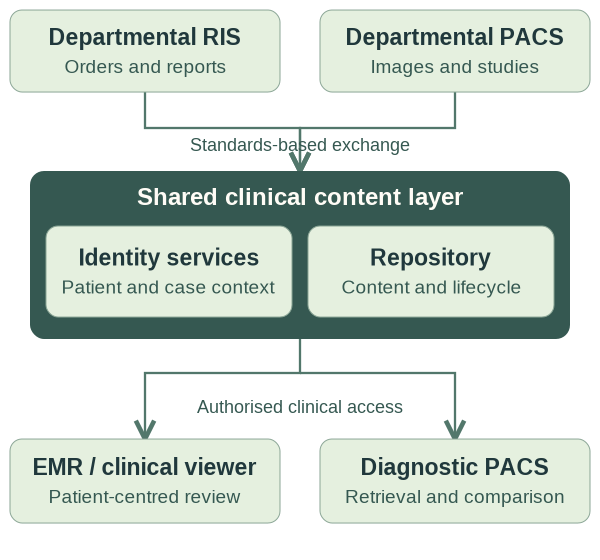
Conceptual illustration of enterprise imaging principles, not a reproduction of the NSW EIR’s technical architecture.
Patient identity across organisational boundaries
One of the more interesting aspects of the EIR was the difference between knowing a patient locally and knowing that same patient across the enterprise.
Some imaging implementations used hospital-level medical record numbers (MRNs), while others used identifiers unique to a wider health service. The same individual could have several legitimate identifiers. Conversely, the same identifier value could refer to different people in different issuing domains.
An enterprise master patient index (MPI) provides a way to associate these records without requiring each hospital to abandon its established patient identifiers. Matching can involve approved demographic rules, address normalisation and resolution of uncertain identities, as well as established identifier cross-references.
The enterprise repository needs to understand these relationships. When a study arrives, it must associate that study with the appropriate patient and retain the context of the originating identifiers. When that study is retrieved by another clinical system, the information must be presented in a form that the receiving system can associate with its own patient record.
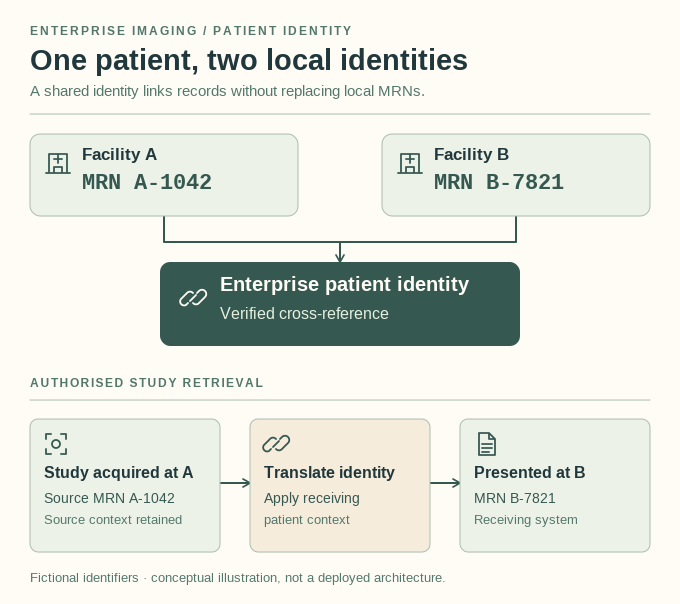
Illustrative patient identity translation. All identifiers are fictional; the diagram describes an architectural principle rather than an actual implementation.
This is an example of why identity translation must be designed for both directions. Normalising identifiers on the way into an archive is not sufficient if the systems that retrieve the information cannot recognise those identifiers.
Patient updates, merges and identity corrections must also propagate appropriately. An uncertain match must not become a clinical association simply because a system needs a patient identifier to complete a transaction.
Interoperability includes the meaning of information
DICOM and HL7 are essential to connecting imaging and healthcare systems. However, two systems implementing the same standard may still represent the same clinical information differently.
Consider an examination code used to describe a chest X-ray. Different RIS implementations may use a short mnemonic, a local numeric code or a more detailed examination-specific catalogue. A common data model allows those different representations to be related, rather than assuming that a code used in one system has the same meaning elsewhere.
| Originating system | Shared meaning | Receiving system |
|---|---|---|
| CXR-PA | Chest X-ray, PA | XR-CHEST-PA |
| XR02-LAT | Chest X-ray, lateral | CXR-LATERAL |
Fictional local examination codes, illustrating mapping between code domains. These are not actual NSW Health codes or billing-item mappings.
The same principle applies to modality, anatomical region and other attributes that can influence how a system searches for or handles a study. Mappings need to preserve clinically meaningful distinctions and explicitly handle concepts that cannot be mapped reliably. A missing match should not be concealed by assigning an approximately similar code.
In an imaging exchange, DICOM attribute coercion is sometimes needed to make the retrieved object usable in the receiving environment. This can include applying the appropriate patient identity or translating locally meaningful attributes. Such transformations should follow agreed rules, preserve provenance and be tested with the receiving system.
The HL7 interfaces carrying orders and reports must be considered alongside DICOM. It is important to maintain associations between the examination, the images and the report, including when information is updated.
During the EIR project, differences between individual implementations mattered even when the installations came from the same vendor. This is why interface specifications, representative test cases and end-to-end validation remain such important parts of healthcare integration.
Standards provide the foundation for interoperability. It is the implementation and validation of those standards across real clinical workflows that makes the information usable.
Bringing historical imaging into clinical workflows
A shared archive creates value when its information is available at the point where a clinical decision is being made.
For a radiologist, that often means having earlier examinations available in the diagnostic PACS. For a referring clinician or specialist, it may mean opening images and reports directly from the electronic medical record (EMR), using a browser-based viewer.
The EIR supported both types of access. Historical examinations could be retrieved into departmental imaging systems, while clinicians could review relevant content through the EMR without needing to operate every originating PACS.
Prefetching is a particularly useful example. A new examination or order can provide the context for retrieving relevant prior studies in advance, so the radiologist has them when reporting. This requires more than the ability to transfer DICOM files: it also depends on reliable patient matching, appropriate selection of priors, compatibility with the receiving PACS and management of the retrieval workflow.
A universal clinical viewer serves a different purpose from a departmental diagnostic workstation. The appropriate viewer depends on the clinical task, the content type and the necessary diagnostic capabilities.
When planning enterprise access, it is worth starting with the actual users and workflows. The system should make the information available in a usable context, rather than simply introduce another place where people need to search for it.
Information outlives the applications
Enterprise imaging architecture also raises questions about information governance and storage management that go beyond the day-to-day work of an imaging department.
Different organisations may share infrastructure while retaining distinct responsibilities for their records. Appropriate logical separation, authorisation and auditing allow information to be shared according to policy rather than making all content available to everyone with access to the platform.
Similarly, retention and availability requirements may vary by content type, patient population or organisation. Enterprise storage policies need to reflect those requirements. Storage tiering, replication, integrity verification and recovery should be considered alongside the expected pattern of clinical access.
A separate archive does not automatically eliminate future data migrations. It can, however, reduce the coupling between the replacement of a departmental application and the management of its historical clinical information.
This independence is one of the enduring attractions of a properly designed VNA.
From enterprise imaging to healthcare content management
Radiology was a natural starting point for enterprise imaging because DICOM provides a well-established foundation for exchanging images. But medical information is produced across many specialties.
Cardiology, endoscopy, pathology, clinical photography and other services can produce content that needs to be accessed in a patient or case context. Some information may be DICOM; other information may be documents, video, biosignals or structured data.
The challenge is to integrate this information in a way that supports its clinical use and respects the responsibilities of the applications and organisations that produce it.
| Architectural function | Role in the clinical information environment |
|---|---|
| Integration | Connect systems and establish the patient, examination or case context. |
| Viewing | Present relevant content together in a form appropriate to the clinical task. |
| Sharing | Make information available to authorised users and systems across organisational boundaries. |
| Archiving | Maintain durable, accessible clinical content independently of short-lived application changes. |
These are distinct capabilities. They need to work together, but an organisation may already have suitable components for some of them. Not every piece of clinical content needs to be physically moved to a single repository for it to become accessible through an integrated architecture.
This is one reason Healthinc sees value in JiveX Healthcare Content Management (HCM), developed by VISUS. Its modular architecture explicitly includes integration, viewing, sharing and archiving, allowing those capabilities to be introduced alongside existing clinical systems.
JiveX HCM is a different technology from the Evercore platform used in the original EIR. We see continuity in the architectural principles, not in the products themselves. The experience of implementing enterprise imaging has informed our interest in clinical content platforms that can act as a cornerstone for integration rather than simply provide another archive.
What to establish before choosing a platform
Whether the scope is a multi-site imaging practice, a hospital or a broader healthcare network, the questions that determine the architecture are often similar:
- Which information needs to be available, to whom, and in which clinical workflows?
- Which systems are authoritative for patient identity, clinical context and content?
- How will different identifiers, code domains and interfaces be reconciled?
- Which existing systems should remain in place, and where is additional capability needed?
- How will access, information retention, retrieval and recovery be governed and tested?
The answers will guide the choice of applications, interfaces, archive and viewing technology. Some organisations will need a full enterprise content platform; others may benefit from introducing one or two missing capabilities first.
The NSW EIR experience reinforced for me the importance of understanding the clinical information and the systems that produce it before deciding how to connect them. That remains a fundamental part of Healthinc’s systems integration approach today.
References
- eHealth NSW — Enterprise Imaging Repository
- Freeman Wong, HealthManagement (2014) — The Enterprise Imaging Repository
- AuntMinnie (2012) — Statewide imaging repository takes off in Australia
- Fujitsu Australia (2013) — NSW Premier's Award for the EIR
- Radiology Business (2015) — Fujifilm acquires TeraMedica
- VISUS — JiveX Healthcare Content Management
- VISUS — The modular HCM architecture